
Japanese Black Pine Moyogi: Reading the Informal Upright Black Pine and Choosing One
The most common combination you will see in pine bonsai is the Japanese black pine grown in the informal upright style, called moyogi in Japanese. Moyogi is a style in which the trunk rises while curving left, right, forward and back. Black pine suits it remarkably well, and growers have produced it in large numbers for generations.
This article focuses on what makes a black pine moyogi worth looking at. For how to read the informal upright style itself, see what is moyogi.
Why Black Pine Suits the Informal Upright Style
Japanese black pine carries its needles in pairs; they are thick, stiff and sharp. Because of those prickly needles and bark that cracks into plates with age, it has long been called the "male pine" in Japan.
The appeal of moyogi is the strength of a trunk rising through its curves. Black pine thickens readily and its bark roughens with age, so the movement of the curves combines with the thickness and ruggedness of the trunk, making even a small tree look like an old giant. That is why black pine is the classic moyogi tree.
Four Things to Look At
1. A thick base
The section from the soil to the first curve is called the tachiagari, or rise. In a black pine moyogi, the more solid the base and the more the roots grip the soil, the more impressive the tree. A short tree with a thick base has simply been grown for a long time.
2. Rugged bark
Black pine bark is smooth when young, but with age it cracks and lifts into scale-like plates. This roughness is the great charm of a black pine moyogi. Rough bark on the outside of curves or around swellings makes the movement of the trunk even stronger.
3. The order of the curves
As with any moyogi, the ideal is for the curve nearest the base to be the largest, with curves getting smaller and closer together toward the top. Black pine is vigorous, so upper branches and the apex tend to grow strong and some trees look top-heavy. In photos, check that the upper curves are not larger than the lower ones.
4. Tiered branches and needle length
A black pine moyogi looks settled when branches growing from the outside of the curves are arranged in tiers to the left and right. Left alone, black pine needles grow long; in bonsai they are kept short and even with techniques such as cutting the new shoots in early summer. Short, even needles and compact branch tips are a sign of a well-kept tree. See Japanese black pine care for timing.
How It Differs From White and Red Pine Moyogi
The same style gives a very different impression depending on the pine.
- Black pine: thick, stiff needles and rugged bark. Powerful and bold.
- Japanese white pine: needles in bundles of five, short and soft, gathering in rounded clusters at the branch tips. Refined and gentle.
- Japanese red pine: thin, soft needles and reddish bark higher up the trunk. Light and graceful.
Choose black pine for presence, white pine for softness, and red pine for lightness. We cover red pine in Japanese red pine bonsai.
Nishiki Pine: a Black Pine With Especially Rough Bark
Nishiki pine is regarded as a variety of black pine. Its bark grows thick and cracks like cork, a trait called arakawa ("rough bark"). Kokubunji in Kagawa is known as a place where Nishiki pine has been grown since the Meiji era.
In a Nishiki pine moyogi, the bark takes center stage even more than in a black pine. If you enjoy dramatic bark more than trunk movement, compare a Nishiki pine as well.
What to Check When Choosing From Photos
- Base thickness: if the product page lists the trunk thickness at the base, compare it with the height. The thicker the base relative to the height, the more solid the tree looks.
- Height of the first curve: the lower the first curve, the more a small tree looks like a large one.
- Top-heaviness: are the upper branches so dense that the apex looks heavy?
- Needle color: deep green is a sign of health. Look out for an overall yellowish tone or brown tips.
- Balance with the pot: black pine moyogi are often planted slightly off-center in rectangular or oval pots.
If something cannot be seen in the photos, please ask through our contact form.
Black Pines Available Now
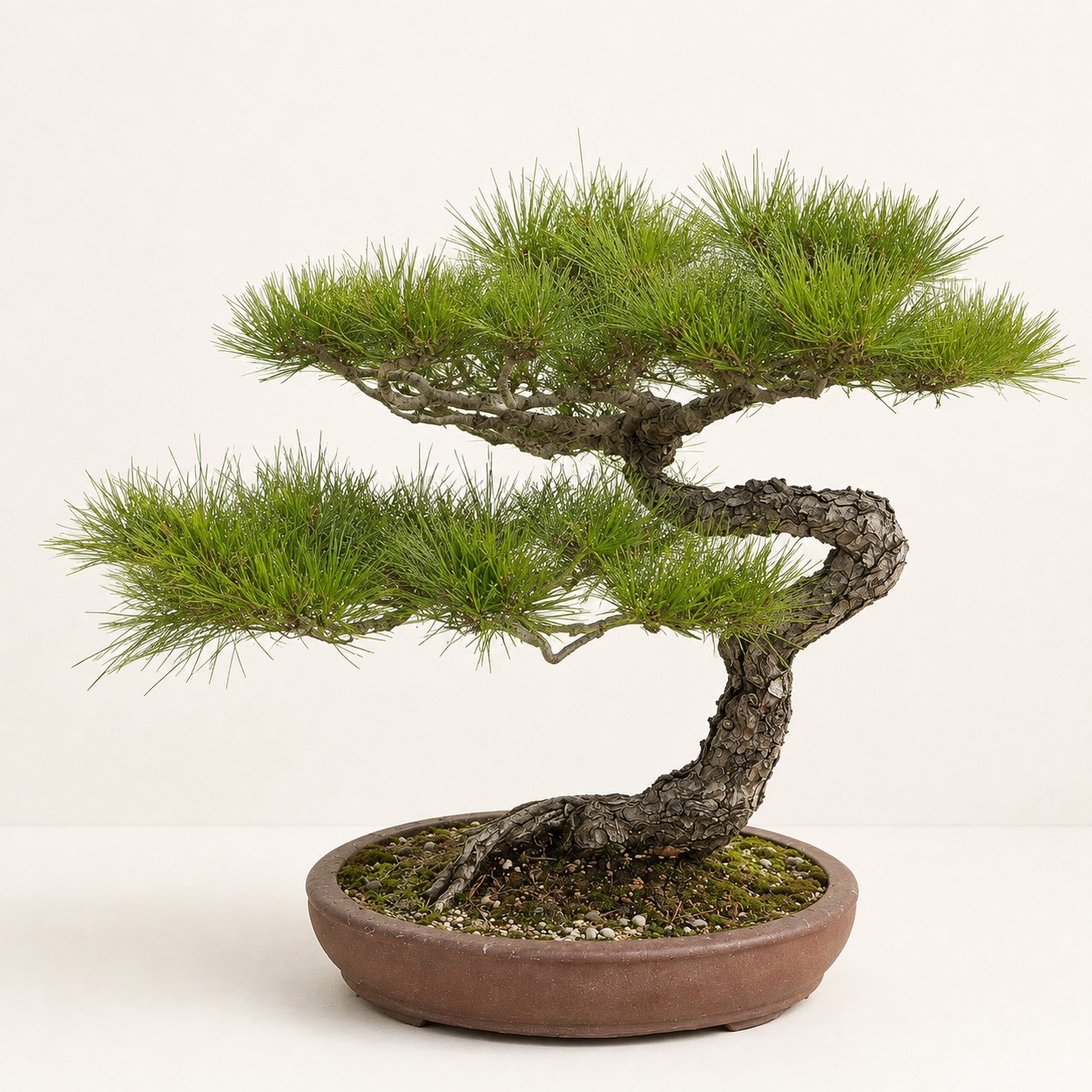
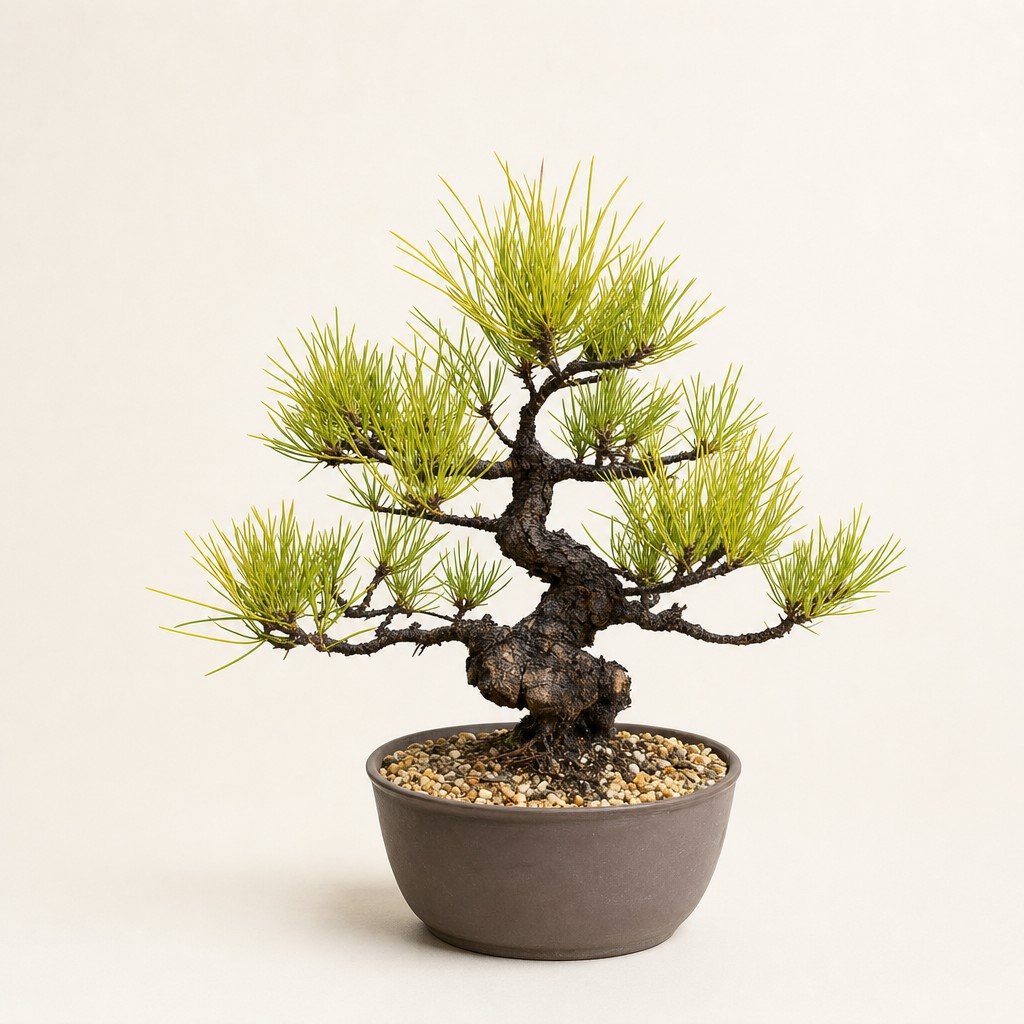
Our Japanese black pine (slanting, informal upright) features a trunk that curves as it rises at a slant, with rugged bark. At about 51 cm tall, it has real presence.
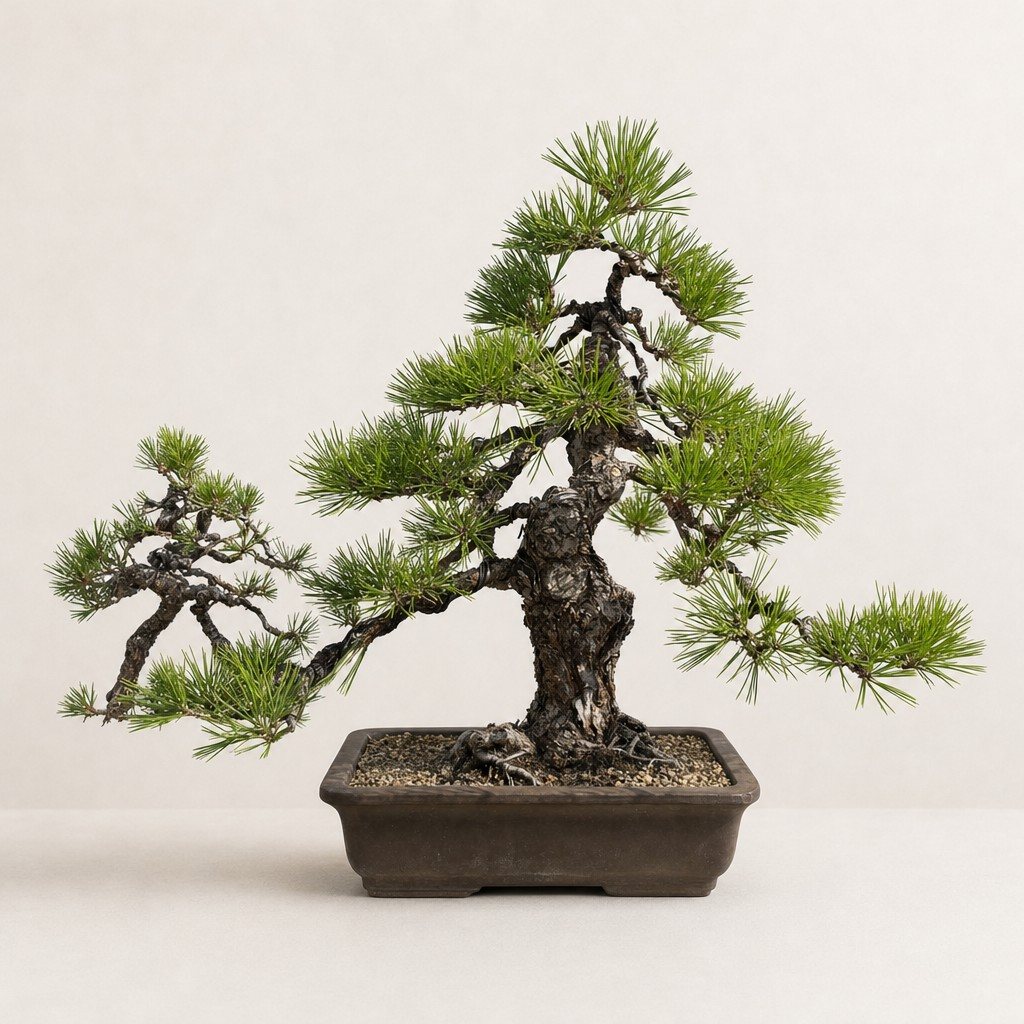
Our Japanese black pine (small, rugged bark) is only about 30 cm tall, yet its trunk is about 8.5 cm thick at the base. Its twisting trunk and rough bark speak of many years of growth.
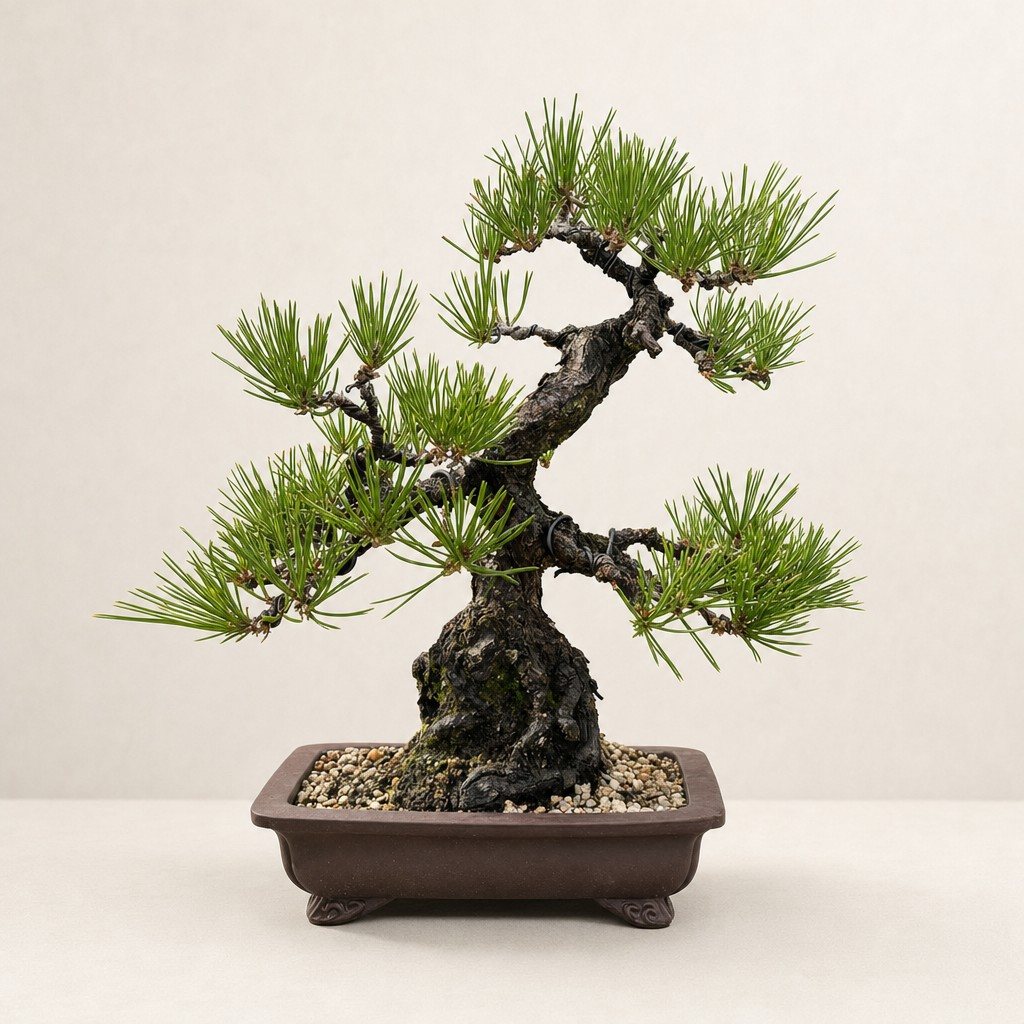
To judge a black pine moyogi, cover the needles with your hand and look only at the trunk. A thick rise and curves in the right order: a tree with both never gets old to look at.
For other styles, see bonsai styles explained; for shaping branches with wire, see wiring basics. We ship within Japan only.
Frequently Asked Questions
Can a beginner grow a black pine moyogi?
Black pine is hardy and easy to grow if kept outdoors in sun and good airflow and watered thoroughly when the soil dries. It is not an indoor tree, so first make sure you have a balcony or garden space for it. See Japanese black pine care for details.
Black pine or Nishiki pine: which should I choose?
Choose black pine to enjoy trunk movement and a powerful form, or Nishiki pine to enjoy thick, cork-like bark. Many Nishiki pines are reasonably priced, and they are a popular first pine bonsai.
What should I do when the needles grow long?
Left alone, black pine needles grow long. In bonsai, needle length and density are controlled by cutting new shoots in early summer and thinning old needles in autumn. Bad timing weakens the tree, so check the timing in pruning and pinching basics first.