

What Is Moyogi? How to Read the Informal Upright Style and Choose a Good One
Of all the words that appear in bonsai listings, moyogi (informal upright) is the one you will see most. Several of our black pines and white pines carry it. The trouble is that "a tree with a curving trunk" describes almost every bonsai, so the label alone tells you very little.
This guide explains what separates a fine moyogi from an ordinary one, looking at three things: how the trunk curves, where the branches sit, and how the trunk thickens. Later on we cover how these trees are actually made, and what to check when you are choosing from photographs.
Not Just Curves, but Curves in the Right Order
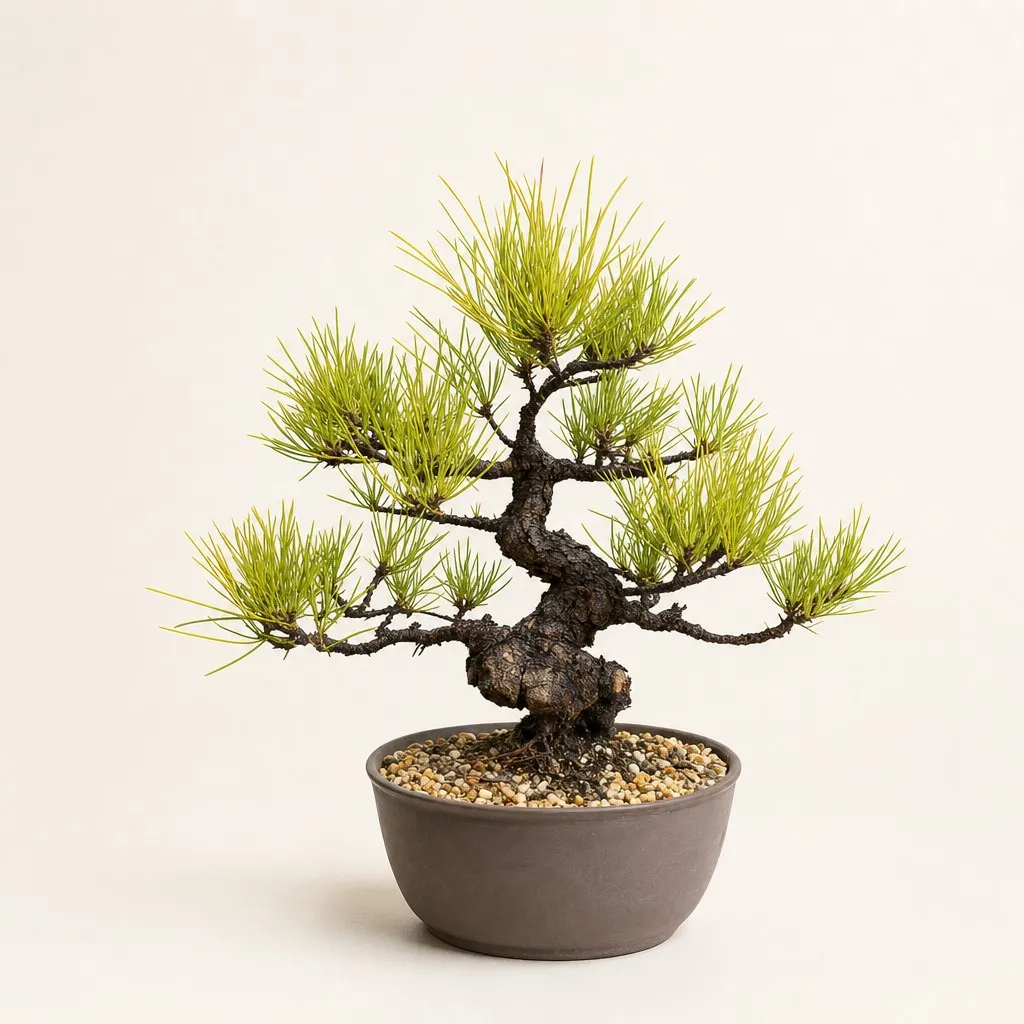
In the moyogi style, the trunk rises from the roots to the apex (the very top of the tree) while bending left and right, forward and back. It echoes a tree in the wild that has shifted direction little by little as it grew toward light or away from wind. It is the most common style in bonsai and suits almost any species.
Any curving trunk can technically be called moyogi, but the memorable ones share a trait: the curves get smaller in sequence. The bend nearest the base is the largest; moving upward, each bend becomes smaller and the bends come closer together. When that order holds, the trunk looks both relaxed and stable.
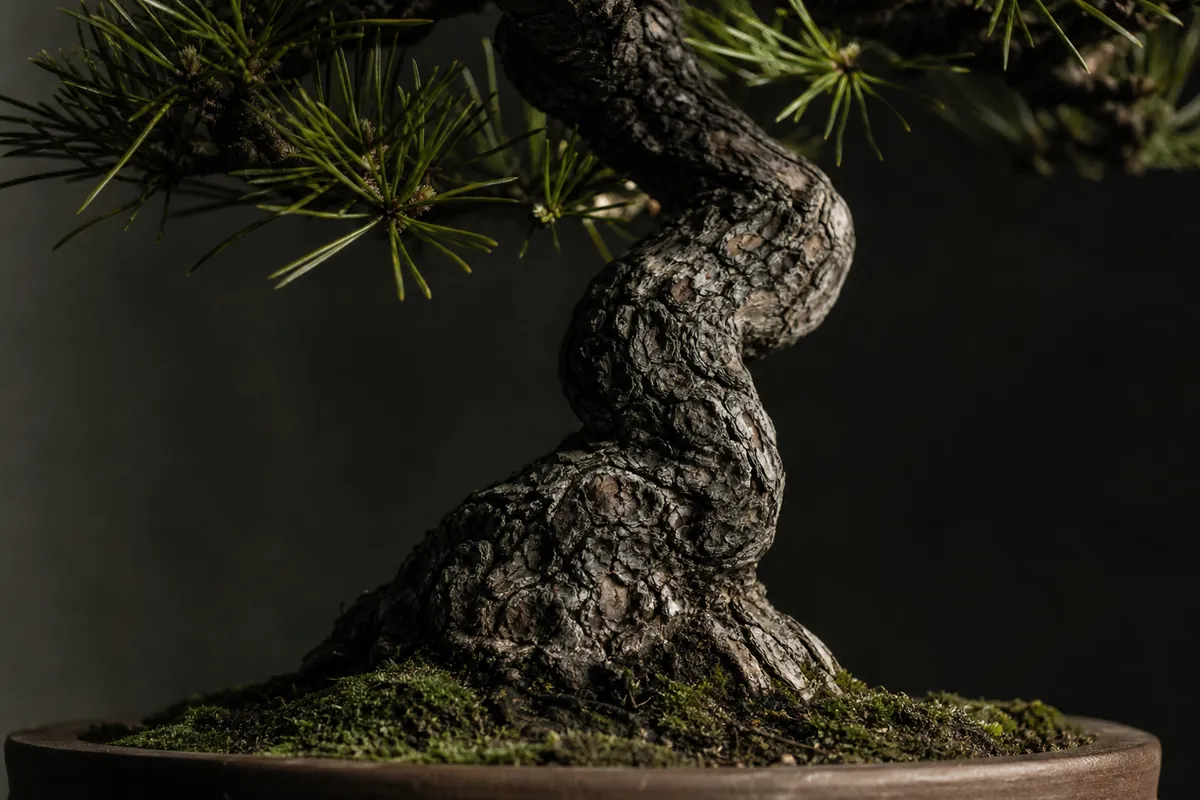
When a large bend appears high up, or bends of the same size repeat at even intervals, the tree starts to look manufactured. When you look at a photo, trace the trunk line with a finger and watch how the size of each bend changes.
Four Things to Look At
1. The Base of the Trunk
The section from the soil to the first bend is called the tachiagari, the rise. It sets the first impression. A thick, confident base and a first bend that comes low on the trunk give even a short tree the presence of a large one.
2. Branches Grow From the Outside of Curves
In a classic moyogi, branches emerge from the outside of each bend, the convex side. A branch from the inside of a bend fights with the line of the trunk, so such branches are usually removed during training. A common guideline is that the lowest branch looks settled at around one third of the tree's height.
3. Taper
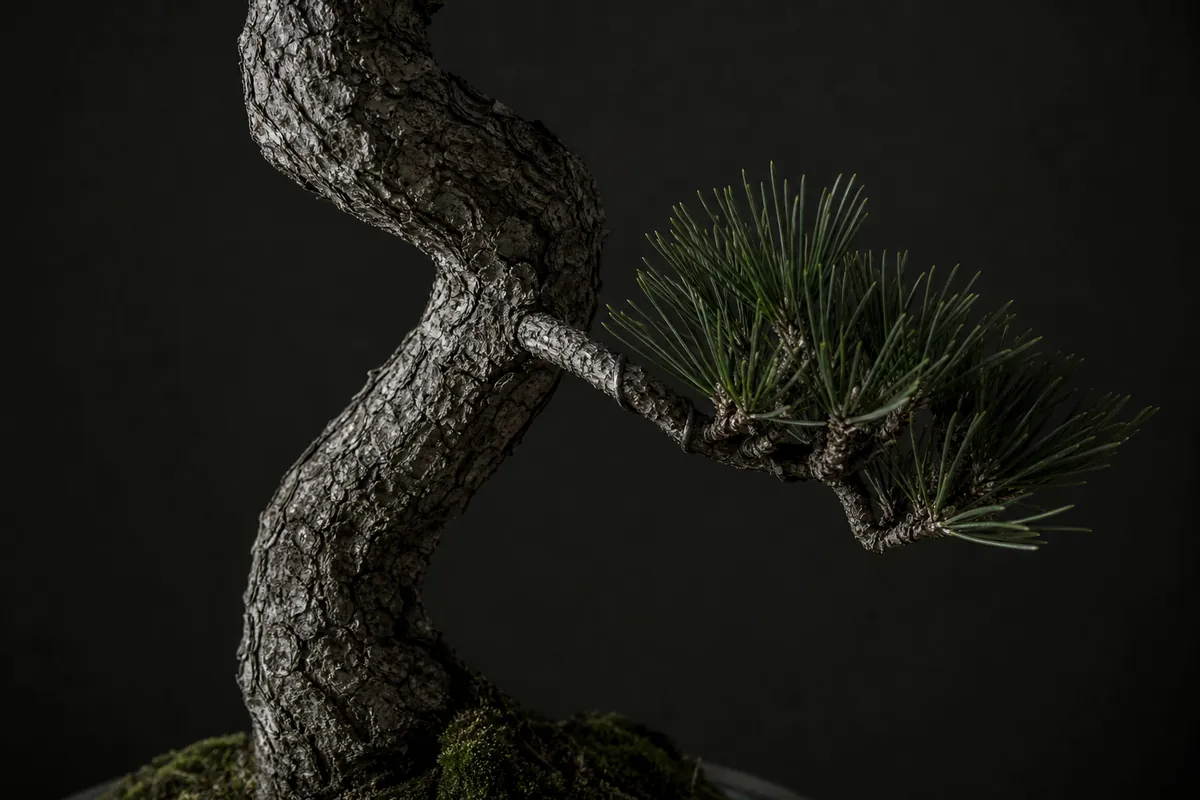
Taper is the way a trunk narrows naturally from base to tip. A trunk that pinches suddenly, or looks thicker higher up than lower down, is said to have poor taper. With moyogi it is easy to be distracted by the curves, but the change in thickness matters just as much.
4. An Apex That Leans Toward You
In a good moyogi, the apex tilts slightly toward the viewer, almost like a bow. That small lean makes the tree feel as though it is reaching out to you. Product photos are normally taken from the front, so this is one of the easier things to check on screen.
How Moyogi Are Made in the Growing Region
Look up how to create a moyogi and you will find plenty of instructions for bending a trunk with wire. That is the mechanism, but a real moyogi is made by repeating two jobs: putting in movement, and building thickness.
In pine-growing areas such as Kinashi and Kokubunji in Kagawa, the movement is wired into the trunk while it is still slender, and the tree is then grown on for years. To thicken the trunk, growers let certain branches run long on purpose, so-called sacrifice branches, and cut them away once they have done their job. Fine branching comes after that, and finally the branch tips are refined into pads. Every moyogi offered for sale carries years of this cycle.
That is why bending a thick trunk dramatically at home is difficult and risky for the tree. A more realistic path is to start with material that already has movement and adjust branch positions gradually with wire. Our wiring basics guide covers the technique.
What to Check When Choosing From Photos
Buying online, you cannot turn the tree in your hands. Checking these points one at a time in the photographs goes a long way toward avoiding the "not what I expected" moment when the box arrives.
- The distance from soil to first bend. Is the rise too long? A lower first bend reads as sturdier.
- Curves shrinking toward the top. Does a large bend reappear partway up?
- Wire scars. Look for spiral grooves in the bark. Old marks fade over the years; fresh, deep ones last a long time.
- Balance with the pot. Moyogi are often planted slightly off-center in an oval or rectangular pot. Does the tree's position match the direction the branches spread?
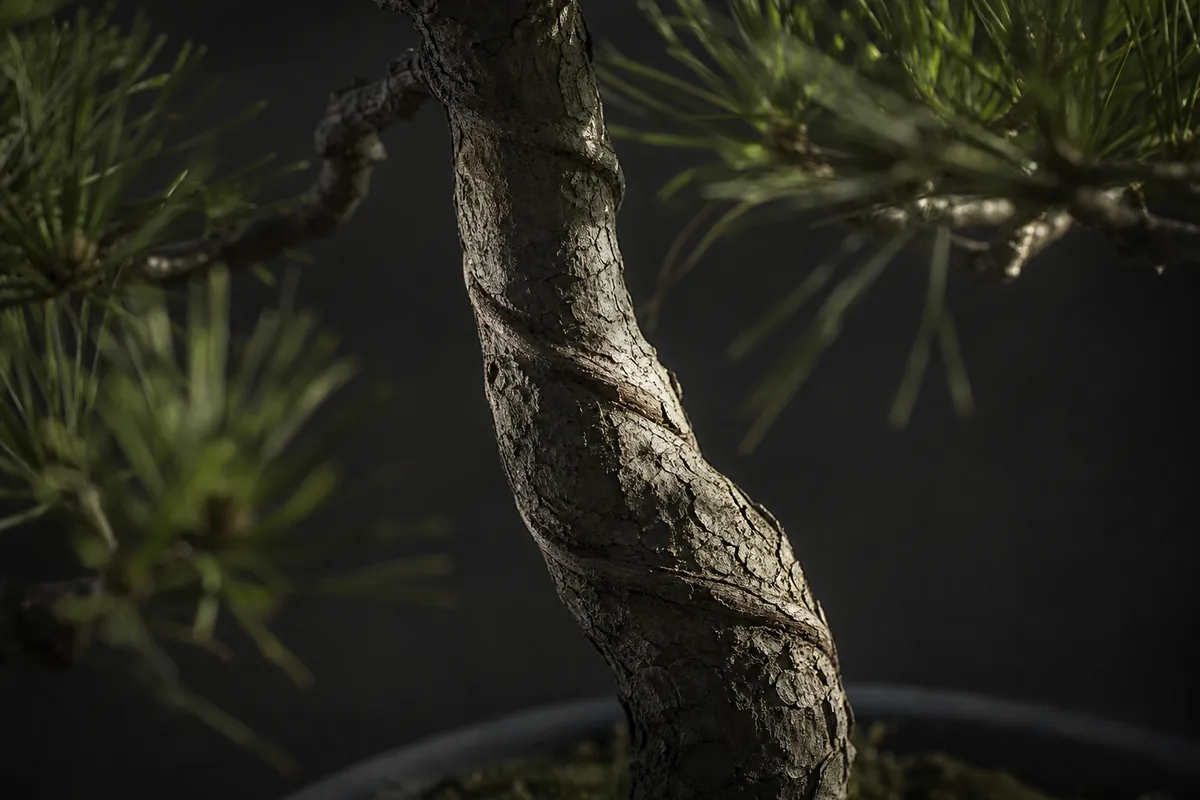
We are adding height and other measurements to product pages as we go. If something you need is missing, just ask through our contact form.
What Sets the Price of a Moyogi
Two black pine moyogi can differ in price by a factor of ten. The biggest factors are trunk thickness and the years of training behind it. As described above, building a thick trunk means years of growing and cutting back, so a tree with a broad base and good taper costs more.
The other factor is how refined the branching is. A tree whose fine branches are gathered into tiers, with dense branch tips from every angle, has simply been cared for longer. Our guide to bonsai prices goes into more detail.
A Style That Fits Almost Anywhere
Because branches extend in a balanced way front, back, and to both sides, a moyogi looks complete on a crowded bench or alone on a display stand. It does not need the tall stand a cascade calls for, or the open space that suits a literati tree. That ease is part of why so many people choose moyogi for a first tree.
Species brings its own character. A black pine moyogi has rugged bark and power, a white pine has short needles gathered softly at the branch tips, and a red pine has reddish bark and fine needles that keep it light. In our collection, the Japanese Black Pine (Informal Upright) (sold) and the Japanese White Pine (Wide-Spreading Form) (sold) are both moyogi. Try running through the four points above as you look at their photos. Among red pines, the Japanese Red Pine (Informal Upright, Two-Tiered Branches) (sold) is also a moyogi.
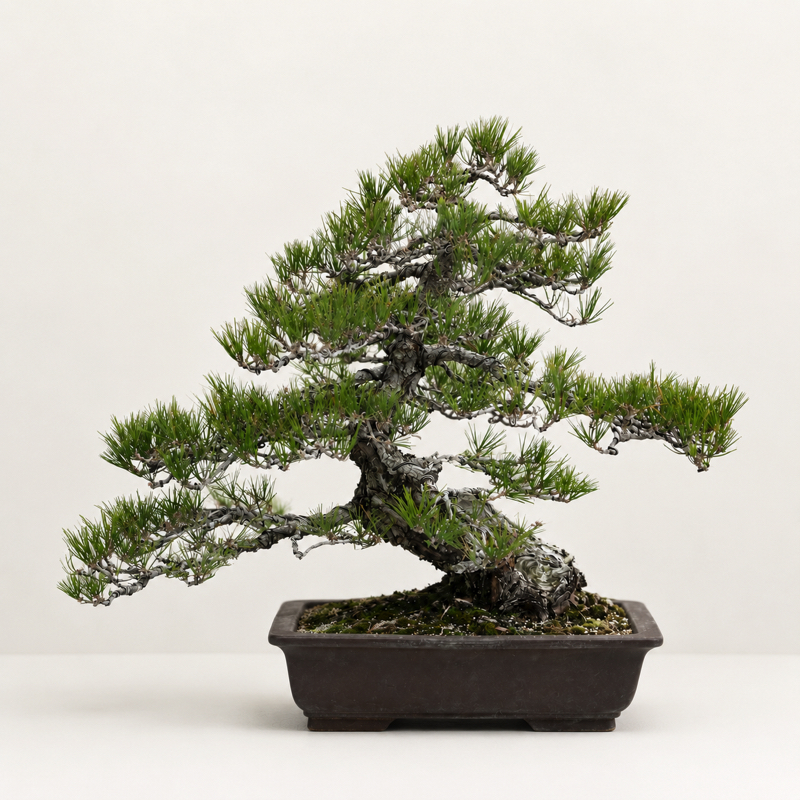
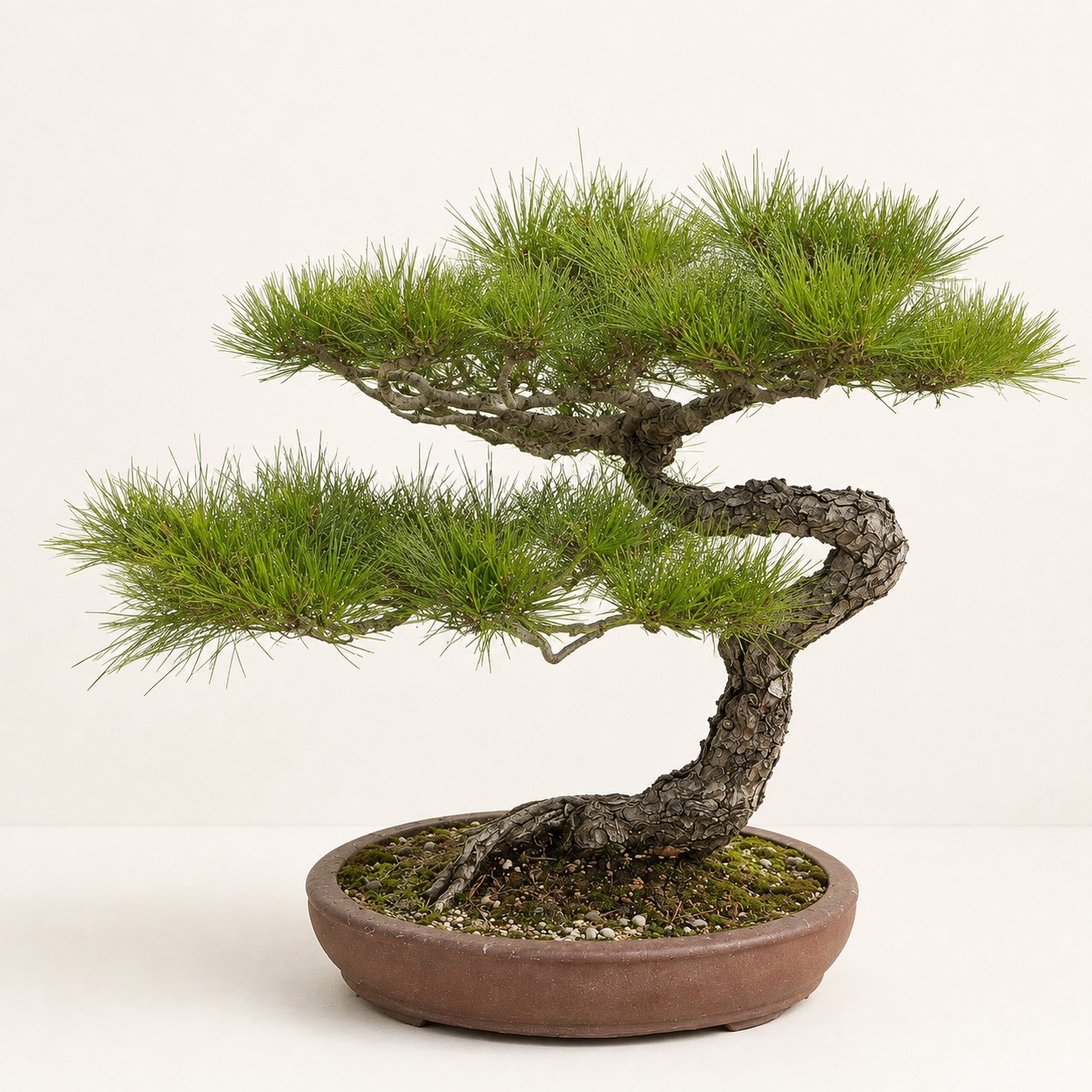
When comparing moyogi, try shrinking the photo until only the trunk line is visible. Once the leaves and fine branches disappear, the order of the curves and the quality of the rise become surprisingly obvious.
For how moyogi compares with other styles, see bonsai styles explained; for finding the front of a tree once it arrives, see displaying and appreciating bonsai. To compare informal upright trees side by side, browse our bonsai collection. We ship within Japan only.
Frequently Asked Questions
Can I reshape a moyogi tree after it arrives?
Bending a thickened trunk is difficult and easily damages the tree, so we do not recommend it. If you want to work on it, start by gradually adjusting branch angles with wire. Timing and when to remove wire are covered in wiring basics.
My moyogi tree still has wire on it. Should I remove it?
Wire comes off once the branch has set in position. Left on, it bites in as the wood thickens and leaves spiral scars that last for years. Check from time to time that it is not cutting in. Rather than unwinding it, snip the wire off in short pieces to avoid damaging the branch.
How do I find the front of a moyogi tree?
As a guide, the front is the side where the base and the sequence of curves show best and the apex leans slightly toward you. Turn the pot a little at a time and look for the angle where the tree looks most settled. More in bonsai display and appreciation.